Wall Demolition: Instructions & Tips
Turn two rooms into one, make small spaces feel big: with a wall demolition, you can design your home exactly the way you want. Grab a sledgehammer and just go for it? Better not! We provide tips for both load-bearing and non-load-bearing walls. We show you what to look out for, what costs to expect, and which tools are best for making your DIY "wall demolition" project a complete success.

Wall Breakthrough Checklist: What You Need to Clarify in Advance
- Written permission if you are renting
- Floor plan of your home
- Structural engineer's report
- Building permit, if applicable
You can find the floor plan at your local building authority. It shows you which walls are load-bearing, where utility lines run, etc. A building permit is required if:
- the wall breakthrough affects a load-bearing wall,
- it involves an exterior wall,
- the building is a protected historic landmark.
Our tip: Always play it safe with a major construction project like a wall breakthrough! Coordinate with your local building authority and structural engineers. This not only saves you from nasty surprises, but also from demolition orders or high fines.
Load-bearing vs. non-load-bearing walls – how to tell the difference
Only a structural engineer can truly determine which type of wall you are dealing with. However, there are a few rules of thumb. Load-bearing walls usually include:
- Exterior walls
- Wall thicknesses of 6.9 inches (17.5 cm) or more
- Masonry walls of 4.5 inches (11.5 cm) or more (built in 1990 or later)
With older buildings, it gets more complicated, making expert advice especially important.
You can usually identify non-load-bearing walls by their sound: if it sounds hollow when you knock, it is likely a drywall, which you can generally remove easily – as long as there are no utility lines in the way!
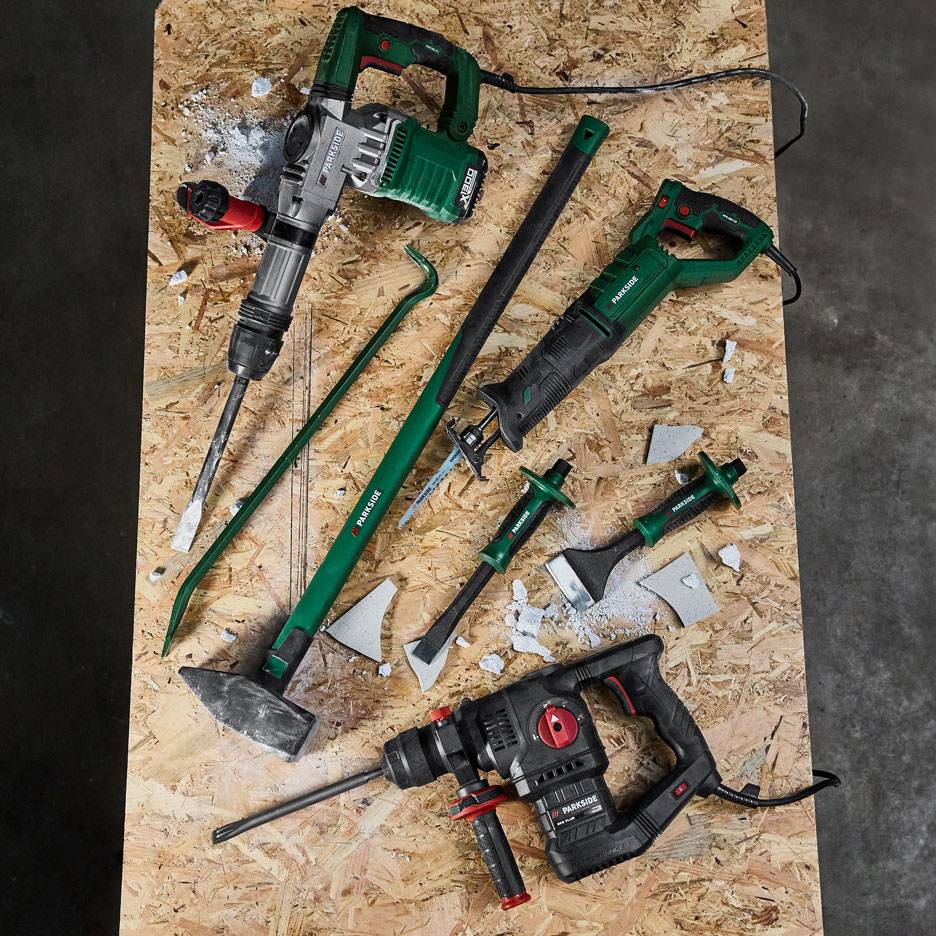
Which tool for breaking through a wall?
For breaking through a wall, you need to bring out the heavy artillery. The most important power tools and hand tools are:
- Rotary hammer: Tool with serious power for solid masonry
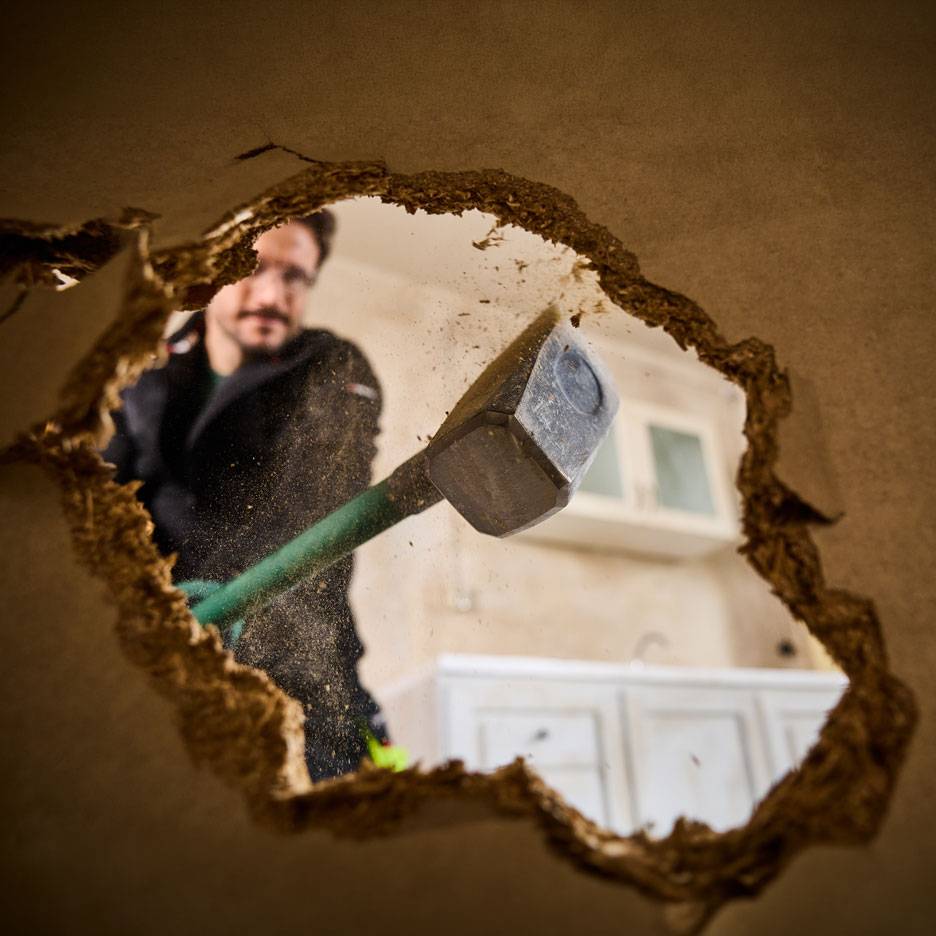
- Sledgehammer: When it comes to the rough stuff – perfect for the initial breakthrough
- Angle grinder (with diamond blade): For cuts in drywall or lightweight blocks
- Hammer & chisel: Experts for fine touch-ups and lightweight materials
- Core drill: For precise, circular openings for pipes
Tool Tip: For thin walls made of drywall or similar building materials, your rotary hammer should have 10 to 20 Joules of impact energy; for thicker walls, 20 to 50 Joules are required.
Wall Breakthrough for Non-Load-Bearing Walls: Instructions & Tips
Leave the breakthrough of a load-bearing wall to the professionals. For a non-load-bearing wall, proceed as follows:
- Tools ready and put on workwear (hearing protection, safety goggles, protective clothing, work gloves, safety shoes).
- Cover adjacent rooms with plastic sheeting – including floors, walls, and furniture.
- If necessary, mark the breakthrough – especially for a door or window. Be a bit more generous with the measurements.
- Using a sledgehammer or rotary hammer, first chisel off the plaster, then switch to the drilling function. Drill a hole every 2–4 inches along the breakthrough line.
- Remove debris, install doors or windows, plaster the wall breakthrough – for example, with drywall elements or plaster. Fill gaps with expanding foam or cement.
Wall Demolition: Calculating Costs Correctly
How much your wall demolition will cost depends on many factors. There are various calculations that primarily depend on whether you hire professionals or do it yourself. Added to this are the labor costs of the contractors as well as flat-rate travel fees, costs for relocating pipes and cables, etc. Get an estimate on-site and compare the offers. Pay attention not only to the final sum, but above all to the scope of services!