Sun and Wind to the Rescue: How to Efficiently Dry Laundry Outdoors
Laundry gently fluttering in the breeze, smelling wonderfully fresh even when stored in the closet: drying laundry outdoors is a true joy and possible almost anywhere. This most eco-friendly drying method might require a little more effort than using a tumble dryer, but it also comes with many benefits. This article explains how to best dry your laundry outside and what to keep in mind when choosing the perfect spot – whether it's a balcony, patio, or backyard.
Contents
Drying your laundry outside comes with several great benefits:
- Drying your clothes in the fresh air is completely free
- Saving energy is also great for the environment
- Line-dried laundry feels naturally soft
- Clothes dried outdoors smell incredibly fresh, even without fabric softener
- Unlike drying indoors, it won't increase humidity or the risk of mold in your home.
If you're not in a rush and can skip the dryer, drying your laundry outdoors is highly recommended all around.
Laundry can be dried on the balcony, the patio, or in the yard. When choosing the right spot, several factors play a key role: first, you will need enough space to set up a drying rack, clothesline, or rotary dryer. Second, the location should have good air circulation so that the evaporating water can disperse quickly. A very small, covered balcony or a loggia may therefore not always be ideal. When drying laundry in the yard, make sure the clothes are not hanging directly under a tree to avoid dirt and bird droppings. And of course, a slightly sunny spot is better for drying than a shady one. However, keep in mind that too much direct, harsh sunlight can cause colored fabrics to fade.
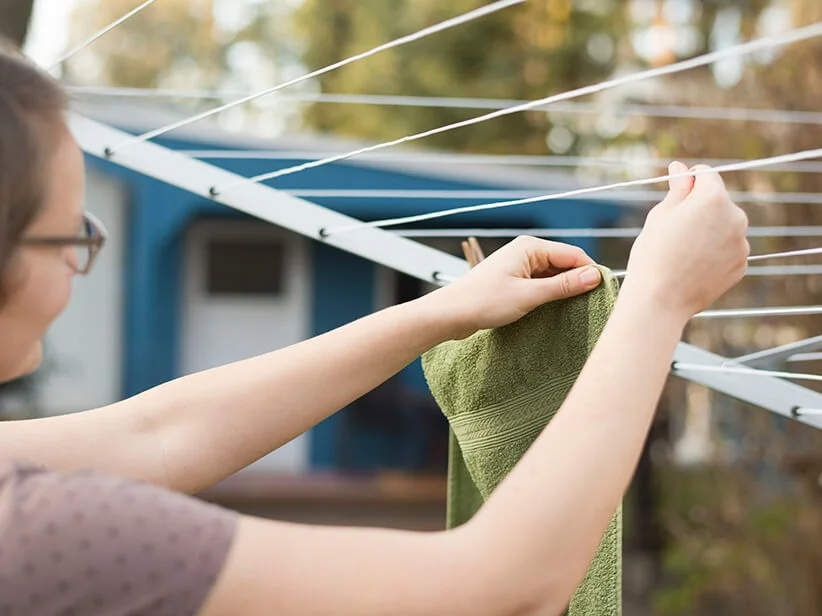
How should you hang your laundry?
To dry your laundry outside, you need to get the right equipment. For smaller balconies, compact drying racks are ideal. However, these have the disadvantage that only a smaller amount of clothing can be dried. Large items like bed sheets either take up the entire rack or hang on the floor. There is usually a bit more space on the patio, so a larger drying rack can be set up. In the garden, setting up a rotary dryer that is firmly anchored in the ground is a great option. These can hold and dry large amounts of laundry at the same time. If you prefer, you can also stretch a simple clothesline between two trees. The more space left between the individual pieces of clothing, the faster they will dry.
To ensure your laundry hangs securely and doesn't fall or blow away, it should be fastened with clothespins. The pins themselves can be stored in a practical little basket. A laundry basket should also be handy so you can easily bring the dried laundry back into the house or apartment.
What weather conditions are best for drying outdoors?
It goes without saying that drying laundry outdoors in the rain is not a good idea. But other than that, laundry can be dried outside all year round – even in freezing winter temperatures, thanks to sublimation. Temperature is actually secondary when hanging laundry outside. Ideal conditions are dry air and a light breeze, allowing the moisture to evaporate from the clothes quickly and efficiently. If the humidity is too high, the air cannot absorb the moisture from the laundry as well, and the clothes will stay damp longer. Wind, on the other hand, whether warm or cold, speeds up evaporation, shortening the drying time.

Weather conditions | Drying time |
|---|---|
Sunny, light wind, 59 to 68 °F | 4 to 8 hours |
Strong sunshine, dry air, 77 °F and above | 2 hours |
No sun, less than 59 °F | Up to 3 days |
Dry air, below 32 °F | 1 to 2 days |